

From Constraint, Connection: Recenses/Recencies by Patrick Madden
Reviewed by Courtney Ruttenbur Bulsiewicz

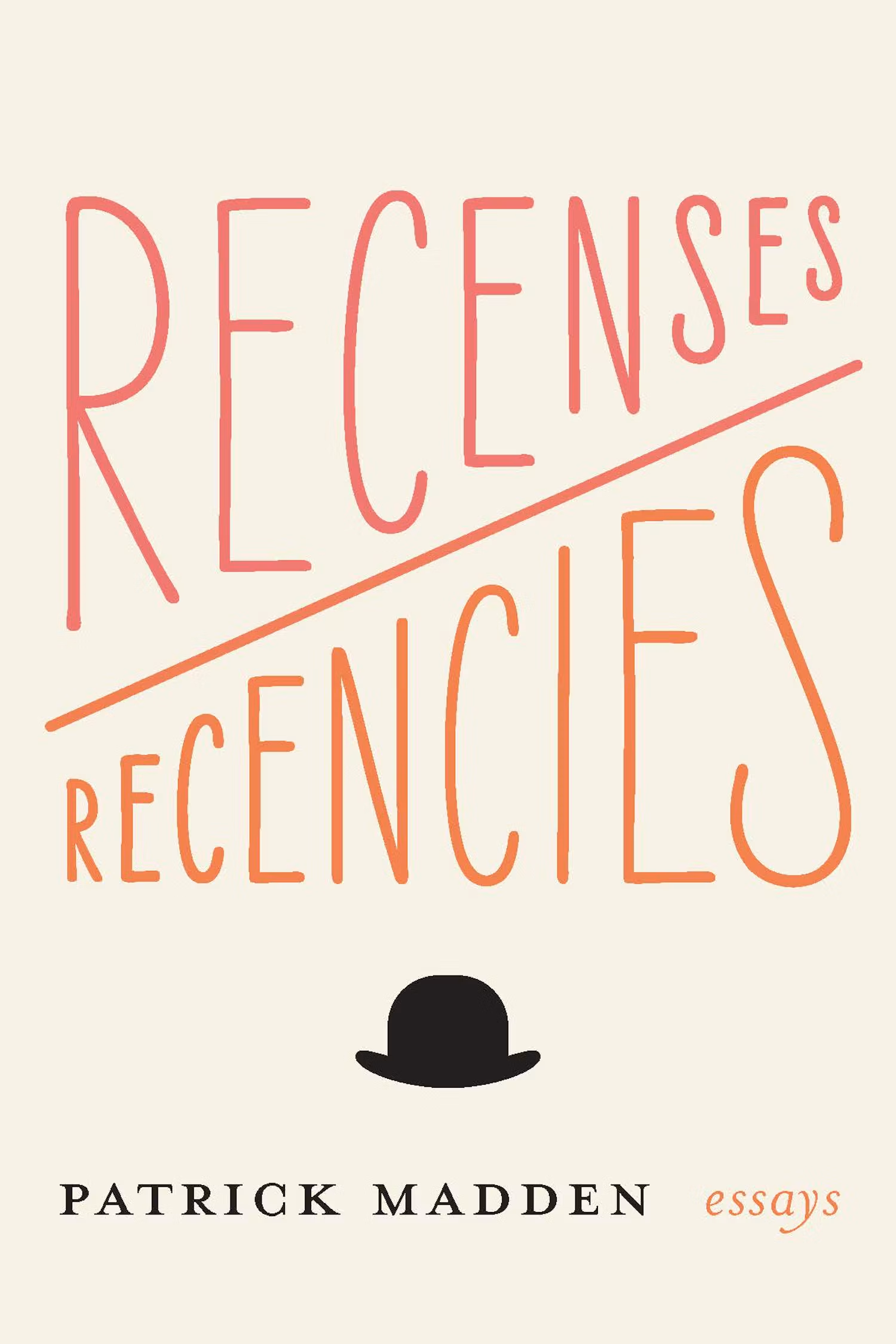
University of Nebraska Press, 2026
I have just spent too long thinking about how to start this review of Patrick Madden’s newest essay collection, Recences/Recencies, and finally settled on the construction you see used, because it seems the only way, really. “I have just” as an opening is a formal constraint Madden imposes on each of his brief essays in this collection. So, though other reviews may turn up with this same opening, because it feels so expected, how great would that be? All of us readers following Madden, following Montaigne, and writing on what we have just—and discovering, as Madden does, how remarkably fruitful such a small spark can be.
Each time I turned the page to the start of an essay, I was eager to see how Madden would turn the phrase “I have just” into a new lens for viewing and understanding everyday life. Sure, he uses the familiar construction of the phrase followed by a simple verb, “I have just overheard,” but some of my favorite moments in the collection are when he shakes it up to make the phrase do something different: “I have just about had it,” “I have just the best friends,” and “I have just enough sugar.” Madden’s variations on “I have just” reveal how much meaning can shift within a seemingly familiar construction, moving a phrase from marking the recent past to expressing emphasis, frustration, sufficiency.
The continuous reinvention of the “I have just” also reflects the broader work Madden does in this collection to try and push back against the inherent limitations in language; he writes, “If you’d never taken NyQuil, my description would get you nowhere near the taste” and in the same essay, “Even this, all this alliterative description, does so little to get you there.” It’s interesting that to explore and even try to break down limitations of language, Madden imposes a limitation on his own.
Over and over, Madden points out what can never be conveyed, “What we have here, despite my attempts at rendering scene, moment, emotion, is but the summary of that summery day. Meaning as relativity. Meaning as reaching. As failed re-creation, failed realization. As something unwieldy, variable, uncontrollable. A new thing in each receiving perceiving mind.” The writing about writing is peppered throughout many of the essays, and the grievance against its lack is beautifully complicated by Madden’s continuous effort to engage with language anyway, recognizing its ultimate power, either in its ability to finally reach or the encounters created in the reaching: “nonliterary scraps of writing left behind years ago and found in the exact moment of resonant significance, have brought me to a deeper appreciation for the ways words matter, which I affirm despite knowing that the words I’ve written here cannot convey even the smallest part of how they matter.” So even in language’s inability to truly recreate, it doesn’t leave us empty. It connects. Though embedded in language’s nature is a separation from the thing it’s naming, its goal is to connect.
Connection has always been one of my favorite traits of this form, ever since I read Phillip Lopate’s Introduction in The Art of the Personal Essay, when he states that essayists might write about themselves to “make readers feel a little less lonely and freakish.” One of the reasons to essay is to lessen alienation, to speak to one another across distances that separate us; Madden’s ever-present attention to the reader, direct address, and conversational style brings us closer to this union—tries to lessen the gap between where he just witnessed, overheard, pondered, and where we sit in reading his accounts of those justs.
“What I mean is, it’s all subjective, all dependent on context, all coming from somewhere and participating in the milieu, all connected: words or drumbeats, the attempt that is this essay, trying to say something new via arrangement of words and ideas amidst all the things that have been said before, to you, whoever and wherever and whenever you are and whatever you bring to your reading.”
The connections being woven in this collection are deliberate and cumulative. These pieces, all connected by the author who wrote them, the phrase that opens them, the reader who turns the page on them, are also connected through content. It becomes clear that not only is “I have just” an echo in this piece, but so is friendship, family, revision. I read this collection over only two days, being pulled into the momentum of the form, how the essays end but then begin again, how the whole book could be one long “I have just,” how each of us is one long stream of “I have just.” I found myself wondering how Madden came to know when to no longer essay about what he had just.
Less than halfway through the collection Madden essays on the Carina Nebula and writes “We might spend a lifetime chasing ideas down this rabbit hole.” In my margins, I wrote that I would happily follow that rabbit hole with a writer such as Madden, so astute about the technicalities of language that he can identify its failings, so attentive to life that he can wrest such richness from such small moments, from three small words.
Courtney Ruttenbur Bulsiewicz writes personal essays, poetry, and critical work. Her writing has appeared in The Normal School, River Teeth’s Beautiful Things, Short Reads, and elsewhere. She is a Voertman-Ardoin Fellow and Ph.D. student in creative nonfiction at the University of North Texas, where she explores questions of memory, family, and loss.