
Mythmaking as Self-Making: An Interview with Aza Pace, Author of Her Terrible Splendor
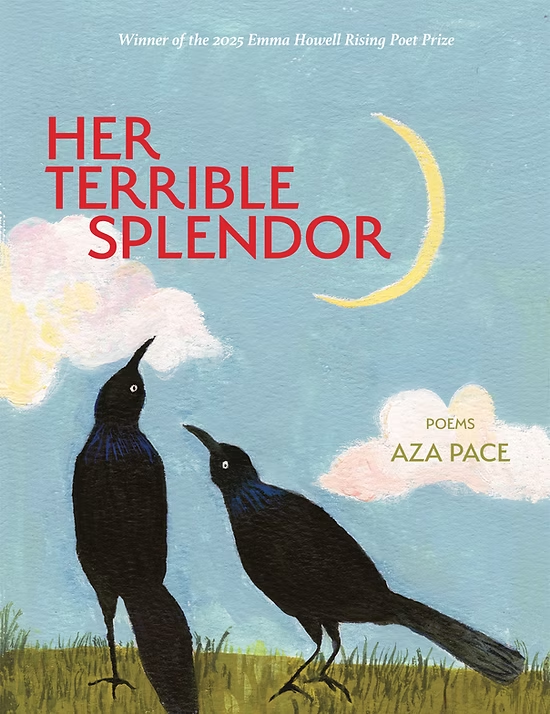
Aza Pace is the author of Her Terrible Splendor, which won the Emma Howell Rising Poet Prize and is now available from Willow Springs Books. Her poems appear in The Southern Review, Copper Nickel, New Ohio Review, Tupelo Quarterly, The Adroit Journal, and elsewhere, and she is the winner of two Academy of American Poets University Prizes. Aza holds an MFA in poetry from the University of Houston and a PhD in Literature and Creative Writing from the University of North Texas. She is currently a Visiting Assistant Professor at Ohio Wesleyan University.
The following conversation took place on March 14, 2025 via a combination of email and Zoom call.
Heather Myers: You are a former ALR editor-in-chief, and a UNT PhD alum! I’d love to catch up and hear what you’re currently doing, and how your PhD work and current work has contributed to your publication of Her Terrible Splendor.
Aza Pace: I started writing the oldest poems in Her Terrible Splendor during my first workshop at UNT, a wonderful class taught by Jehanne Dubrow that focused on writing poems in a series. Later, an earlier version of the manuscript evolved into my PhD dissertation, so my PhD work and the UNT writing community were a huge part of writing the book. Right now, I’m working on a lot of nature poems, and I think the experience of writing HTS, which often takes on the voice of Circe, has helped me think about using persona and poetic form in my newer work too.
HM: I absolutely loved reading Emily Wilson’s translation of The Odyssey and was delighted to see a poem addressing the reading early in the collection. Subjects like feminine power, desire, and secrets arose in this poem. Could you tell us more about how mythology, particularly, Circle, came to influence this work—and particularly, the “voice” of the speaker in the collection?
AP: I’ve always been fascinated by myth and the ways that stories are passed down and changed through time. When I was little, one of my favorite books was D’Aulaires’ Book of Greek Myths, because I sensed that here were stories that might tell me something real about power, love, grief, fury, and peace. But I also immediately wanted to retell and reimagine those stories because they felt limiting in some ways—for girls and women, for example, as well as other aspects of our complex identities. I knew that if I wanted these stories to work for me, I’d have to imagine new ways of telling them. Emily Wilson’s translation of The Odyssey felt like one way of retelling, and I wanted to think about different methods of re-presenting a story, whether in poetry or prose, visual art, dance, etc. and how that process can help us think in a new way. I think it’s Alicia Ostriker who describes using a pre-existing literary figure this way as filling old vessels with new wine.
Circe in particular interested me as this powerful woman whose magic arises from a kind of scientific understanding and kinship with the natural world and who creates a haven for strange animals and lost humans. I wanted to use her story as a way of thinking about what it means to come of age as a woman and as an artist, a kind of mythmaking as self-making that is defined by care and practice rather than loss (as in the Persephone myth). I wanted her to appear in a range of roles in the human speaker’s life—as if anyone could be Circe in the right light—and to consider Circe as if multiplied through a prism. She’s a real magical character in the book, not just a metaphorical one.
HM: Artwork has a great presence in the collection. “Portrait of Nymphs Bathing” is a standout that comes at the start of “Transformations.” I especially appreciated its ordering next to “Eighth Grade Reading”). Could you tell me a little bit more about how artwork, and this act of observation, came to influence the collection? For example, how did you find some of these pieces?
AP: There are a lot of ekphrastic poems in this book, which I wanted to use as another kind of re-presenting. I enjoyed the back-and-forth created by a lyric poem that responds to a painting that responds to an epic poem. I was drawn to the Pre-Raphaelites and to more contemporary artists who have depicted Circe so differently throughout time. The idea of portraiture also goes back to my idea about envisioning Circe in real people, since human women modeled for so many of those paintings. Visual art also feels important to me as a part of my poetic practice—I was raised by two visual artists, so that way of making impacts the way I think and write.
HM: I love the poem, “My So-Called Art,” and its opening: “Circe asks What do you think about form / it’s a revelation / revelation of what /…” Later, the poem “Forms” in the section Transformations talks about a literal transformation, and how “everything is always bending towards a new shape.” Prose poems also appear frequently in this section.Could you tell me a little more about the collection’s form and general organization? What was the process of shaping it like?
AP: The section with the prose poems is all about growing up and building your own story, so prose made sense to me as a form that can focus more on storytelling than my usual lyrical style. I also try to use form to emphasize the difference between persona poems in the voice of Circe and poems that are in the voice of the human speaker. Using line and image in different ways, changing my normal syntax, etc. helped create separate voices for them, and then there are a few “conversation” poems where they both speak.
The book as a whole is organized roughly chronologically as a narrative: Circe appears to the human speaker, helps her discover her own power and sense of self, and ultimately becomes less necessary to the human speaker as a figure or mask because the human speaker has grown up and found storytelling as her own kind of magic.
HM: We must talk about witches! The first poem in the collections opens, “Define Witch,” and also draws on the title of the collection. As a woman who once lived alone, won’t sit still, and often sings under my breath, I very much felt like I was entering, welcomingly, as a witch into the collection. The collection is enchanting; was there any other media or inspiration your drew from to engage in the “witchery?” Your poem “At The Glastonbury Goddess Temple” hints at some earlier inspiration and love for witches, which I’d love to hear more about!
AP: Yes, let’s talk about witches! I’ve always loved witches as a way of thinking about feminine power. It felt important to me that Circe was the source of her own strength and that the human speaker wants to live that way too. While I was writing these poems, I sought out other books about witches and enchantment, but I also turned to music and film to help me find the kinds of rhythm and atmosphere that could evoke Circe’s voice. I’m thinking of films like Portrait of a Lady on Fire or even pop music like songs by Billie Eilish. Really, I was looking for magic everywhere.
HM: The collection culminates into a magnificent celebration of the feminine form—the collection, overall, reads like a love letter to the imagination inside, to femininity, girlhood/womanhood, to the self (to Circe). When you were writing, what did you set out to accomplish with this collection? How did you find your “purpose?”
AP: I love this question because it makes room for the “feminine form” to include more than the body—the mind, the imagination, our sense of self—even though the body is also important here, especially in the context of the visual representations of Circe and her usual depiction as an enchantress or seductress. I find it difficult to write about pleasure and beauty, and I wanted to confront that hesitancy in this book. I especially wanted to think about desire between women and the power of female friendships, so that became a central purpose. After all, I was reaching for Circe as a symbol or way of thinking because I was longing for that kind of connection.
HM: What advice would you give to writers working on their first poetry collection or currently sending their work out?
AP: Don’t give up! It took me several years to find a home for this book after it was finished, and it can be a discouraging process. If you get positive feedback from a press, make sure to resubmit to their next round. And I find it helpful to keep making new work and following my present curiosities so that I don’t feel stuck while I’m submitting an existing manuscript.
Heather Myers is from Altoona, Pennsylvania. She recently earned a PhD in Creative Writing from the University of North Texas. She has an MFA in Creative Writing from West Virginia University. Her work, which was previously awarded an AWP Intros Award, can be found in The Pinch, Door=Jar, The Journal, Palette Poetry, Puerto Del Sol and elsewhere.